Reading & marginalia
After Labor Disappears, Will We Be Free?
An AI Researcher Reads Hannah Arendt—and Makes a Slightly Pessimistic Guess About the AI Age
Open article contents
- Labor, Work, and Action
- A Society of Laborers Without Labor
- What Does Arendt Mean by “Society”?
- I Asked AI to Draw a Picture
- AI Can Let One Person Create What Once Required an Organization
- Liberation from Labor Is Not Freedom
- Why Entertainment May Still Belong to the Cycle of Labor
- The Future May Be a Division, Not an Average
- What Can We Do?
- We May Have Less Time Than We Think
- Finally
I work in a field powered by FOMO and a persistent sense that six months is an era.
As an AI researcher working on large language models, much of my day is spent thinking about how to train models to perform tasks that once required an expert. Can the model write better code? Can it complete a longer research project? Can it operate a computer, detect its own mistakes, correct them, and perhaps help us train the next model?
In Silicon Valley, where automation is less a proposal than a reflex, these questions feel perfectly natural. Every additional workflow a model can automate counts as progress. Every expert capability it absorbs makes the capability curve a little steeper.
But every so often, when I stop working, another question appears:
What does all of this mean for human beings?
The standard answer is familiar. AI will automate all the dull, repetitive, unavoidable tasks. People will no longer have to spend their lives making a living. They will finally have more time to do what they genuinely enjoy.
It is an appealing vision.
But even before asking how long true automation will take, there is a more awkward question: how many people today know what they genuinely love, or what they would actually choose to do?
During the day, I help train models to replace experts. At night, I wonder what the experts are supposed to do once we succeed. This is a little like dismantling a bridge and then opening a seminar on the philosophy of crossing rivers.
Still, perhaps this is exactly the sort of question technologists should occasionally ask.
Labor, Work, and Action
I have recently been reading Hannah Arendt’s The Human Condition, published in 1958.
Arendt makes a distinction that looks simple at first and becomes more unsettling the longer one thinks about it. She divides the active human life into three kinds of activity: Labor, Work, and Action.
These words are easy to misunderstand because she does not use them in their ordinary sense.
Labor: the cycle that sustains life
Labor consists of the activities that must be repeated in order to keep life and daily existence going.
A meal is prepared and then eaten. A room is cleaned and becomes dirty again. The body rests and grows tired again. An organization processes today’s messages, tickets, reports, and maintenance requests, only to receive another batch tomorrow.
Labor is not defined by whether it is unpleasant. It is not defined by whether someone is paid for it.
Its defining feature is simpler:
Labor is never finally complete.
It belongs to a cycle of production, consumption, maintenance, and renewed production. As long as biological life and social systems continue, the activities that sustain them must continue as well.
Work: building a relatively durable world
Work, by contrast, creates something that can remain.
A house, a bridge, a book, a piece of furniture, a software system, an institution, or a long-lived public project may all count as Work.
None of these things lasts forever. But unlike a meal, they are not exhausted in a single act of consumption. They can be used, inherited, repaired, modified, and passed on. Some may outlive the people who made them.
The point of Work is therefore not merely output.
Through Work, human beings build a relatively durable world in which they can live together.
Action: beginning something new with others
Action is the most difficult of the three concepts.
It does not mean clicking a button, executing an instruction, or “taking action” in the ordinary managerial sense. For Arendt, Action takes place between people.
Through speech and deed, a person appears before others and reveals who they are. They begin something whose outcome cannot be completely calculated in advance, and they accept responsibility for what follows.
Political participation, public argument, organizing a movement, founding a community, persuading others to begin a shared project—these may all contain Action.
Its central concerns are not productivity and efficiency, but:
- human plurality;
- the beginning of something new;
- freedom in a shared world;
- and responsibility for consequences.
Labor corresponds to the process of life. Work corresponds to the human-made world. Action corresponds to the political space created when different people live and act together.
These are not three occupations. They can all appear in the same occupation, or even within the same day.
A programmer may spend part of the day dealing with repetitive incidents and maintenance—the realm of Labor. They may spend another part building a software system intended to last—the realm of Work. And they may participate with others in deciding what the project should become, which risks to accept, and which future to pursue—the realm of Action.
This essay will not discuss thinking, or whether LLMs allow human thought itself to be outsourced. That question involves understanding, judgment, consciousness, authorship, and responsibility. It is deeper, harder, and deserves a separate essay. Arendt herself did not include thinking within the main framework of The Human Condition.
A Society of Laborers Without Labor
Only after distinguishing Labor, Work, and Action can we understand one of Arendt’s most famous warnings:
Automation may produce a society of laborers without labor.
The phrase sounds contradictory.
If labor has disappeared, how can people remain laborers?
Arendt’s point is that modern society has trained most of us to understand ourselves primarily as laborers.
From childhood, we are taught a sequence that appears almost self-evident:
- education is preparation for employment;
- employment provides income;
- income sustains life;
- leisure restores the energy required to return to employment.
Nearly every occupation becomes a way to make a living. Nearly every period of rest becomes preparation for more production.
In such a society, the disappearance of labor does not automatically turn people into makers or political actors.
It may simply produce laborers who no longer have labor.
They are finally free from work, but they no longer know what freedom is for.
Arendt’s fear was not merely that automation might fail. It was that automation might succeed after we had forgotten which human activities could make its success worthwhile.
What Does Arendt Mean by “Society”?
Arendt also uses the word society in a way that differs from ordinary speech.
She does not simply mean “a collection of people” or “human civilization.”
A simple picture may help.
In the ancient structure she reconstructs, the household dealt mainly with necessity:
- food;
- reproduction;
- property;
- labor;
- survival.
The public realm dealt with another category of questions:
- How should we live together?
- What is worth doing?
- What direction should the city take?
- Who should answer for a collective decision?
With the rise of modern society, many concerns that had once belonged to the household expanded to the scale of the entire nation:
- How many jobs exist?
- How much do people earn?
- Is production growing?
- Is the population healthy?
- Is consumption strong?
- How should welfare be distributed?
- Is society stable?
These are obviously important questions. But when they become the whole content of public life, politics begins to look increasingly like management.
The nation becomes a household enlarged to an enormous scale. Government becomes the system responsible for measuring, distributing, predicting, maintaining, and correcting the life of that household.
This is roughly what Arendt means by the rise of the social realm.
In simpler terms:
The question “What kind of world should we create together?” is gradually replaced by “How can everyone’s life be managed more efficiently?”
AI is exceptionally well suited to the second question.
It can predict, allocate, monitor, optimize, recommend, and automatically execute. It may therefore become more than a tool used by particular individuals. It may gradually become the operating system of the giant household itself.
I Asked AI to Draw a Picture
So I did something mildly ironic, but entirely appropriate to our time: I asked AI to create an Arendtian chart of the changing relationship among Labor, Work, and Action over the course of human civilization.
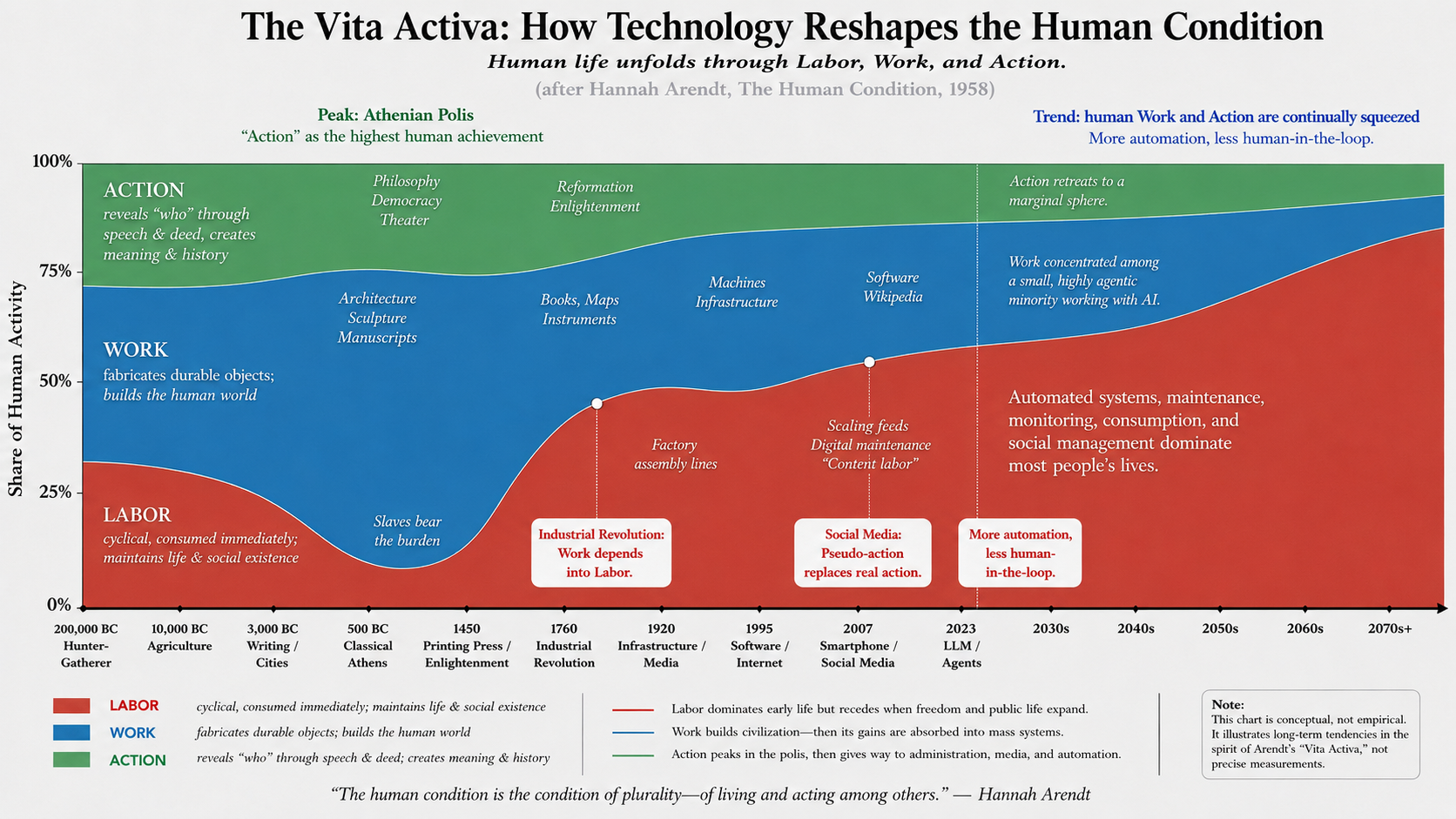
In the chart, the pre-LLM world develops roughly as follows:
- Hunter-gatherer life and early agriculture: Most human activity is governed by survival. Labor occupies the center.
- Writing, cities, and architecture: Human beings begin to create objects that can outlast an individual life. Work expands.
- Classical Athens: A minority of citizens escape necessary labor and enter the polis, pursuing excellence and immortality through speech and action. Action reaches its peak. This freedom, of course, rests on women, slaves, and noncitizens carrying the burden of necessity.
- The printing press, the Reformation, and the Enlightenment: Books, maps, instruments, and public argument enlarge the human-made world and create new spaces for public Action.
- The Industrial Revolution: Machinery expands productive power, but it also breaks integrated craftsmanship into repetitive operations on an assembly line. Much Work is reorganized as Labor.
- Mass media, the internet, and the smartphone: Software, infrastructure, and projects such as Wikipedia continue to build a digital world. At the same time, feeds and social platforms convert more public expression into predictable, measurable, and consumable behavior.
- The age of LLMs and agents: AI begins to move from generating individual answers to executing complete workflows—from assisting human fabrication to planning, calling tools, operating in digital environments, and reducing the amount of human involvement required.
The chart makes only one claim about the future:
As automation becomes more capable, human Work and Action will be increasingly squeezed.
This requires clarification.
The expansion of the red Labor region does not mean that everyone in the future will spend more hours in paid employment. The opposite may happen. Traditional employment may decline substantially.
The red area represents the logic of Labor: repetition, consumption, maintenance, recovery, and renewed consumption. It describes the structure around which life is organized, not merely whether a person has a job.
AI Can Let One Person Create What Once Required an Organization
My most optimistic interpretation of LLMs is that they compress an enormous amount of knowledge and professional capability into infrastructure that an individual can call upon.
A person with sufficient agency may use AI to:
- build software that once required an entire team;
- produce a film, game, book, or course alone;
- conduct research, design, data analysis, and prototyping;
- organize projects that previously required a large institution.
Under this interpretation, LLMs can radically amplify homo faber—the human being as maker.
One person can create more Work, rather than merely perform more Labor.
LLMs themselves provide a useful example. They embody years of Work performed by a relatively small population of researchers and engineers, yet they may replace or reorganize the cognitive labor of a much larger population.
Robotics may produce a similar structure. Systems built by relatively small teams may eventually take over a vast amount of physical labor.
But AI primarily lowers the barrier to how something can be done. It does not automatically answer several other questions:
- Why should it be done?
- What is worth making?
- What is worth preserving?
- Which project am I willing to remain responsible for over time?
Work is not the same thing as output.
Generating a thousand videos that will be forgotten within minutes does not necessarily create more Work than spending five years writing a book that people continue to read.
AI can produce a spectacular quantity of output. Only a small part of that output will become part of a shared human world.
In the past, the scarce resources may have been knowledge, technical skill, capital, and organizational capacity.
In the future, the scarce resources may instead be:
- purpose;
- taste;
- judgment;
- selection;
- long-term commitment;
- idealism.
AI can democratize means.
It does not automatically democratize ends.
Liberation from Labor Is Not Freedom
Now the original question returns.
Suppose AI and robotics eventually perform most cognitive and physical labor. People no longer have to work in order to survive.
What happens next?
An intuitive answer is that everyone begins to create Work. People write books, make art, investigate the universe, and build new things.
But this intuition depends on a hidden assumption: that every person already possesses a genuine passion, buried somewhere inside, waiting to emerge once employment stops consuming their time.
I increasingly doubt this assumption.
An interest is not always a hidden object waiting to be discovered. It is often formed through a long process:
encountering a practice, trying it, being bad at it, meeting resistance, gaining a little competence, receiving feedback from others, entering a community, and eventually deciding that the activity deserves one’s time.
A person does not necessarily begin woodworking because they love woodworking.
Often, they begin to love woodworking only after doing it for some time.
AI can reduce the barrier to entering a field. That is valuable.
But if it also removes:
- practice;
- delay;
- failure;
- resistance from materials;
- the process of learning alongside other people;
then users may remain permanently at the stage of sampling possibilities.
A song in five minutes. A game in ten. A short film in thirty. Every possibility can immediately be exchanged for another.
A person may possess unlimited creative capability while becoming unable to form a durable attachment to any particular creation.
Time is not direction.
Capability is not purpose.
The absence of Labor does not automatically produce Work.
It certainly does not automatically produce Action.
Why Entertainment May Still Belong to the Cycle of Labor
Entertainment is not the same thing as Labor.
Rest, play, games, and amusement are not moral failures. Human beings cannot spend every moment creating durable objects or participating in political Action.
The problem is that modern entertainment increasingly takes on a temporal structure similar to Labor:
It is produced, immediately consumed, and rapidly replaced by another product.
Short-form video makes this structure unusually visible:
stimulation, satisfaction, boredom, scroll;
stimulation again, satisfaction again, boredom again, scroll again.
The process has no point of completion.
You cannot finish the feed, just as you cannot eat the final meal that will permanently remove the need to eat.
Consumption quickly recreates the appetite for more consumption.
Even after people cease laboring for survival, they may devote much of their lives to:
- consuming infinitely generated entertainment;
- maintaining health, appearance, and mood;
- optimizing personal experience;
- managing digital identities;
- pursuing game levels and social metrics;
- receiving increasingly precise personalized services.
People may stop being busy in order to survive and become busy optimizing the experience of being alive.
In that world, Labor as employment may decline while the logic of Labor expands.
I am not predicting that everyone will work longer hours.
I am predicting that:
The cycle of production, consumption, maintenance, and renewed consumption may occupy a larger share of human life.
The Future May Be a Division, Not an Average
A chart can easily create the impression that “humanity” is one average person.
The AI future is more likely to produce a severe division.
The AI-Augmented Makers
A relatively small group of highly agentic, long-term, and idealistic people may use AI to produce an increasing share of the world’s Work.
They will define objectives, select problems, organize resources, and use models and robots to perform processes that once required hundreds or thousands of people.
An individual may be able to make what once required an organization.
The Animal Laborans Without Labor
A much larger population may no longer perform traditional labor, yet never enter Work or Action.
They become users who are supported, cared for, entertained, and managed by automated systems.
Life may be comfortable. Material abundance may be real. The range of apparent choice may be enormous. But most choices will occur within menus that the system has already prepared.
These people need not feel oppressed. They may not even feel unhappy.
They simply have fewer reasons to begin something, build something, or decide something with other people.
The most dangerous future may not resemble The Matrix.
It may resemble an exceptionally helpful, endlessly attentive life-management app with no meaningful log-out button.
Action Moves Backstage
AI itself does not perform Action in Arendt’s sense.
A model can send an email, modify code, execute a trade, or allocate resources. These are operations. They are not political Action.
AI is more likely to expand administration, procedure, and management. Questions that once demanded public disagreement may increasingly appear to be technical optimization problems.
Politics then becomes more systematized and administrative.
AI gradually manages the daily affairs of the giant human household. Genuine goal-setting, institutional design, and control over resources move backstage, into the hands of fewer people.
Action is not replaced by AI.
It is squeezed out of ordinary life, or concentrated among the shrinking number of people who retain the authority to define the system’s objectives.
The result could be a peculiar world:
Society produces an enormous amount of Work, but very few people participate in creating it.
Most people no longer perform Labor, yet continue to live inside Labor’s cycle.
AI administers everyday life, while Action survives mainly among system designers, owners, and a small political class.
What Can We Do?
I do not think the answer is to slow down all AI research. Nor do I think humanity should preserve unnecessary drudgery simply because freedom makes us nervous.
AI offers an unprecedented historical opportunity.
The freedom of classical Athens depended on slaves carrying the burden of necessity for citizens.
AI may allow us, perhaps for the first time, to imagine liberation from necessity without transferring that necessity onto another excluded class of human beings.
That could be a remarkably good future.
But liberating people from Labor cannot mean merely eliminating their jobs. We must also build the capabilities and institutions that can convert free time into Work and Action.
First, material freedom must be widely distributed
If the productivity created by AI remains concentrated among a small number of companies and owners of capital, most people will not become free.
They will simply lose bargaining power.
Material security is a necessary condition for entering Work and Action, even though it is not sufficient.
Second, education must cultivate the ability to form purposes and sustain long projects
The scarce ability of the future may not be remembering information.
It may be:
- choosing a problem worth pursuing;
- tolerating a period with little or no feedback;
- continuing after failure;
- remaining committed alongside other people.
Interests are not selected from a menu.
They are formed through practice, community, and resistance from the real world.
Third, we need to define more genuinely AI-driven Work
This will be difficult.
It involves not only the interaction between AI and an individual, but also the relationships among AI, groups, organizations, and public projects.
A good AI product should not merely help people generate more things more quickly.
It should help them:
- build long-term projects;
- retain understanding and ownership of what they create;
- make things that others can use, maintain, and inherit;
- enter genuine cooperative relationships;
- move from disposable outputs toward a relatively durable world.
We should not ask only:
How many tasks can AI perform instead of a person?
We should also ask:
How many people who previously lacked the means to become makers can AI help become genuine makers?
Fourth, we must preserve spaces for Action
Decisions about the goals of collective life cannot all be reduced to technical optimization.
People need:
- the opportunity to question systems;
- the right to reject automated decisions;
- the ability to redefine objectives;
- spaces for public discussion;
- and the possibility of identifying who is responsible.
AI may provide information, model alternatives, and execute procedures.
But political responsibility must remain traceable to particular human beings.
A positive loop would look like this:
AI reduces necessary Labor
→ people enter long-term projects and communities
→ making develops interest, competence, and responsibility
→ people participate in building and governing a shared world
→ human agency grows
→ people use AI to create more Work and Action.
The negative loop would look like this:
AI reduces necessary Labor
→ systems provide more entertainment and consumption
→ people lose the capacity to form purposes
→ they become more dependent on systems to provide choices
→ fewer people enter Work or Action
→ society delegates still more of human life to AI administration.
We May Have Less Time Than We Think
There is one more dimension: speed.
Not every technological curve in human history is literally exponential. But from inside frontier AI research, model capabilities, computational efficiency, agents, robotics, and research automation feel mutually reinforcing.
This is one reason AI laboratories are so intensely FOMO-driven.
If one laboratory pauses, it fears that another will automate the next layer first. If one researcher slows down, yesterday’s research question may become today’s product feature.
So anyone who intends to shape this future must also move quickly.
But speed cannot mean only:
- training models faster;
- deploying agents faster;
- automating occupations faster;
- reducing human involvement faster.
We must accelerate another curve at the same time:
the cultivation of human agency, the construction of new public institutions, the design of human–AI relationships that create genuine Work, and the discovery of uses for freedom before more people become animal laborans without labor.
The capability race has already begun.
The race for human agency should begin as well.
Finally
This essay rests on one large assumption: that the principal political subjects and rulers of Earth over the next several decades will remain carbon-based.
Silicon Valley contains other narratives. Some people believe the most urgent problem is AI safety: alignment, loss of control, and the possibility that more capable AI systems may harm humanity.
Each of these narratives has its own internal logic. I am not trying to dismiss them here.
I simply think that having more people care about human beings is unlikely to be a bad development.
Perhaps the world will rapidly enter the negative loop I have described. Perhaps we will construct a more positive one. Perhaps humanity will continue doing what it has often done—moving between periods of prosperity and destruction, returning to something ordinary, and beginning another cycle.
I do not have an answer.
Arendt did not pretend that one person could provide one either. These questions are ultimately political. They must be answered among many people.
The task she gave us was simpler:
Think what we are doing.
For me, it is interesting to pause occasionally amid an intense working life and think about these questions.
It may also be necessary.
Because while we train models to replace experts, we may need to train ourselves—and our societies—to answer a different question:
When we finally become free, what will freedom be for?
Reading note
This is a personal reading of Arendt from within AI research, not a comprehensive interpretation of The Human Condition. The claims about AI, short-form media, education, and future social division are my own contemporary extensions.
The Human Condition · University of Chicago Press ↗ · Stanford Encyclopedia of Philosophy ↗